

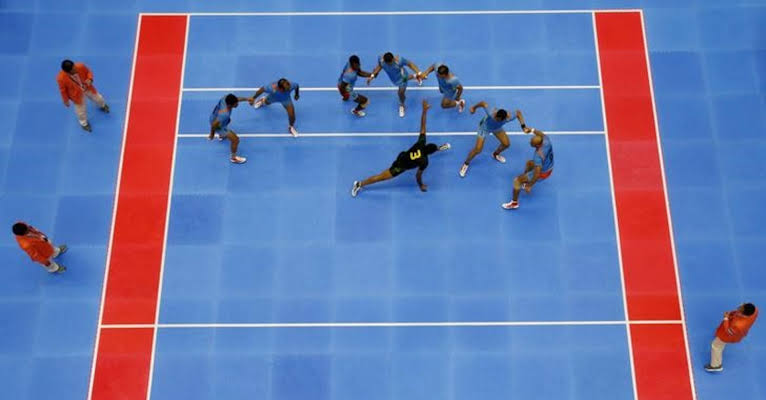
Kabaddi is played on a rectangular court divided into two equal halves by a mid line. The court has specific measurements for men, women, junior boys, junior girls and sub junior players. These dimensions ensure that players compete on a suitable playing surface according to their category.
The standard kabaddi ground measurement for men and junior boys is 13 metres × 10 metres, while women and junior girls play on a 12 metres × 8 metres court. The sub junior category uses an 11 metres × 8 metres court.
Apart from the overall size, the court includes several important markings. These include the mid line, baulk line, bonus line, lobby and sitting block. Each marking has a specific position and purpose during a match.
This guide covers kabaddi court size for every category, the measurements of individual markings and the space required around the playing area.
What Is the Standard Kabaddi Ground Measurement?
The standard kabaddi ground measurement depends on the player’s category. Men and junior boys use the largest court, followed by women and junior girls. Sub junior boys and girls play on a smaller court.
The following table shows the official field of play dimensions, including the 1 metre lobbies on both sides.
| Category | Length | Width | Total Court Size |
| Men | 13 m | 10 m | 130 sq. m |
| Junior Boys | 13 m | 10 m | 130 sq. m |
| Women | 12 m | 8 m | 96 sq. m |
| Junior Girls | 12 m | 8 m | 96 sq. m |
| Sub Junior Boys | 11 m | 8 m | 88 sq. m |
| Sub Junior Girls | 11 m | 8 m | 88 sq. m |
These measurements refer to the complete field of play, including the lobbies. The central playing area is narrower because the 1 metre lobby on each side is included in the total width.
Kabaddi Court Size for Men, Women and Juniors
The court dimensions change according to the competition category. The length, width and position of important markings are adjusted to match the prescribed playing area.
Men and Junior Boys Kabaddi Court Size
The men’s kabaddi court measures 13 metres in length and 10 metres in width. Junior boys use the same dimensions.
The mid line divides the court into two equal halves, each measuring 6.5 metres in length. The baulk line is marked 3.75 metres from the mid line, while the bonus line is placed 1 metre beyond it.
The total width includes two 1 metre lobbies, leaving an 8 metre central width between the lobby lines.
Women and Junior Girls Kabaddi Court Size
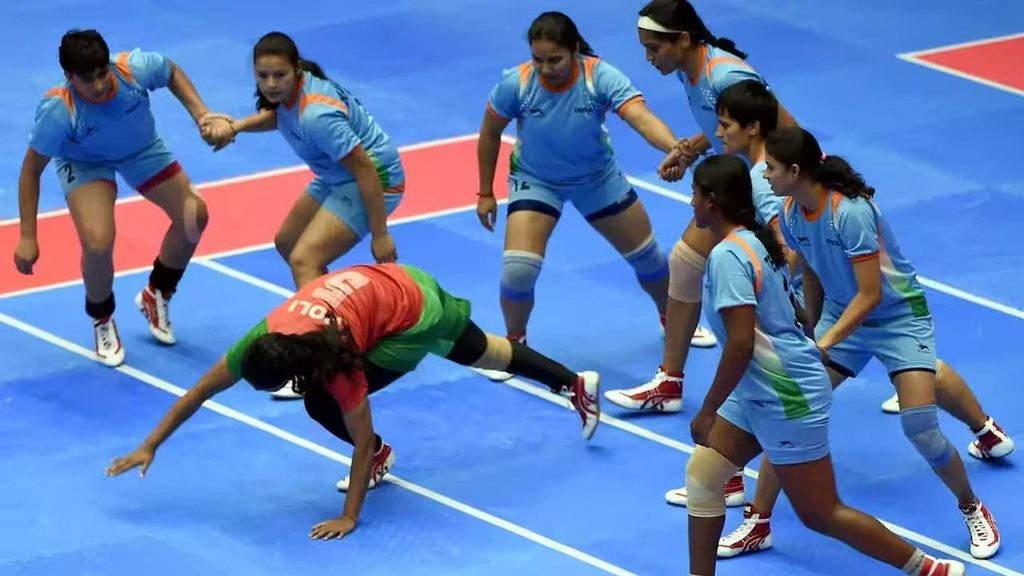
The women’s kabaddi court measures 12 metres × 8 metres. Junior girls also play on a court of the same size.
Each half measures 6 metres in length. The baulk line is marked 3 metres from the mid line, and the bonus line is placed 1 metre beyond the baulk line.
The court has a 1 metre lobby on each side, with a central playing width of 6 metres.
Sub Junior Kabaddi Court Size
Sub junior boys and girls use a smaller court measuring 11 metres × 8 metres.
Each half measures 5.5 metres in length. The baulk line is positioned 3 metres from the mid line, and the bonus line is placed 1 metre beyond the baulk line.
The lobby width remains 1 metre on both sides. The smaller dimensions provide a playing area suited to this age category.
Kabaddi Court Markings and Their Measurements
Every kabaddi court has specific lines and sections that guide players and officials during a match. The measurements of these markings vary slightly between categories.
| Court Marking | Men and Junior Boys | Women and Junior Girls | Sub Juniors |
| Field of Play | 13 m × 10 m | 12 m × 8 m | 11 m × 8 m |
| Mid Line Length | 10 m | 8 m | 8 m |
| Baulk Line from Mid Line | 3.75 m | 3 m | 3 m |
| Baulk Line Length | 8 m | 6 m | 6 m |
| Bonus Line from Baulk Line | 1 m | 1 m | 1 m |
| Lobby Width on Each Side | 1 m | 1 m | 1 m |
| Sitting Block | 1 m × 8 m | 1 m × 6 m | 1 m × 6 m |
| Sitting Block Distance from End Line | 2 m | 2 m | 2 m |
Mid Line
The mid line divides the kabaddi court into two equal halves. Each team has its own half, and the raider crosses this line to enter the opponent’s side.
Its length matches the total width of the field of play. It measures 10 metres for men and junior boys, and 8 metres for women, junior girls and sub juniors.
Baulk Line
The baulk line is drawn parallel to the mid line in each half of the court. It is positioned 3.75 metres from the mid line for men and junior boys, and 3 metres for the other categories.
A raider generally needs to cross the baulk line to make a valid raid, subject to the rules governing touches and other raid situations.
Bonus Line
The bonus line is marked parallel to the baulk line, towards the end line. It is exactly 1 metre beyond the baulk line in all three categories.
The bonus line is important because a raider can earn an additional point by crossing it under the conditions specified in the rules. The bonus point is available when the defending team has at least six players on the court.
Lobby

The lobby consists of two strips running along the longer sides of the court. Each lobby measures 1 metre in width.
The lobby becomes part of the active playing area after a touch or struggle. Its position is important for raiders and defenders because stepping into an inactive lobby can result in being declared out.
Sitting Block
The sitting block is the designated area where eliminated players sit during the match. It is marked 2 metres away from the end line.
For men and junior boys, the sitting block measures 1 metre × 8 metres. For women, junior girls and sub juniors, it measures 1 metre × 6 metres.
Kabaddi Ground Line Width and Surrounding Space
The lines on a kabaddi court must be clearly visible so that players and match officials can identify the boundaries and other markings.
The standard line width is 3 cm to 5 cm. These markings include the boundary lines, mid line, baulk line and bonus line.
The playing area also needs sufficient clear space around the court. A ground measuring approximately 20 metres × 20 metres is desirable. The minimum ground requirement is generally 17 metres × 18 metres, with 17 metres in the vertical direction.
A clear space of 4 metres outside the playing field boundaries is also specified in kabaddi ground layout guidance. This surrounding area provides room for player movement and helps reduce the risk of collisions with nearby structures or spectators.
How to Prepare a Kabaddi Court?
Preparing a kabaddi court requires accurate measurements and clearly marked boundaries. Follow these steps when laying out a standard court:
- Select the playing surface: Choose a level, soft surface or an approved kabaddi mat suitable for the competition.
- Measure the field: Mark the length and width according to the required category, including the lobby areas.
- Draw the boundary lines: Mark all four sides of the field with a line width of 3 cm to 5 cm.
- Mark the mid line: Divide the field into two equal halves.
- Add the baulk lines: Measure the required distance from the mid line and draw a parallel line in each half.
- Mark the bonus lines: Draw another parallel line 1 metre beyond each baulk line.
- Mark the lobbies: Keep a 1 metre strip along both sides of the court.
- Prepare the sitting blocks: Mark the designated player seating areas 2 metres away from the end lines.
- Check the surrounding space: Ensure sufficient clear ground is available outside the playing boundaries.
Before a match begins, officials should check the measurements and make sure all markings are visible and correctly positioned.
Conclusion
Kabaddi ground measurement varies according to the competition category. Men and junior boys use a 13 metres × 10 metres court, women and junior girls use a 12 metres × 8 metres court, and sub juniors play on an 11 metres × 8 metres court. The mid line, baulk line, bonus line, lobby and sitting block must also follow their prescribed measurements. Accurate marking and sufficient surrounding space help ensure a safe and properly organised kabaddi match.
FAQs
The standard kabaddi field of play for men measures 13 metres × 10 metres, including the 1 metre lobbies on both sides.
The women’s kabaddi court measures 12 metres × 8 metres, including the lobbies. Junior girls use the same court dimensions.
The sub junior court measures 11 metres × 8 metres. These dimensions apply to both boys and girls in the sub junior category.
The bonus line is marked exactly 1 metre beyond the baulk line towards the end line. This distance remains the same for men, women and sub junior categories.
A ground measuring approximately 20 metres × 20 metres is desirable. The minimum requirement is generally 17 metres × 18 metres, along with clear space around the playing boundaries.